
Imagine you could look inside the brain of a Tibetan monk as he reaches enlightenment after 40 years of meditation. What would you see? A neurological fireworks display that blows past everything scientists ever thought possible.
That's exactly what researchers have now done, and their discoveries are revolutionizing our understanding of meditation, consciousness and human potential.
The shocking truth about your meditation sessions
Let's be honest: maybe you've been meditating for years. Ten minutes here, 20 minutes there. Maybe even every day. And yet... where's the enlightenment? Where are the transcendent states? Where's that inner peace everyone keeps talking about?
The brutal truth: 99% of all meditators in the West never reach the states of consciousness described in the ancient scriptures. That's not because they're doing it wrong. It's because our modern brains work in a fundamentally different way.
WhatsApp messages. Instagram notifications. The deadline tomorrow. The argument with your partner. The bill that still needs paying. Our brains are in neural chaos, running at full speed 24/7 and constantly stuck in fight-or-flight mode.
A Tibetan monk in the Himalayas? He has none of that. No distractions. No digital dopamine hits. Just him, the mountains and 8-12 hours of meditation a day. And after 20-40 years, something magical happens in his brain...
The monk who left scientists speechless
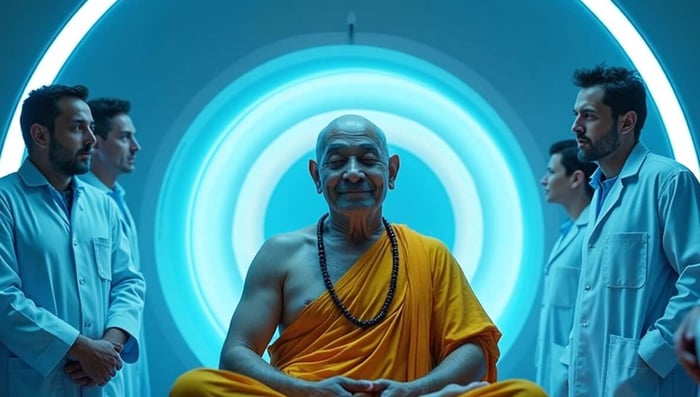
2004, University of Wisconsin. The researchers can't believe their eyes. In front of them sits Mingyur Rinpoche, a Tibetan monk. 62,000 hours of meditation. That's 25 years of his life spent in absolute silence.
They hook him up to 256 electrodes. "Please meditate on compassion," they ask him. What happens next blows their instruments off the charts.
His gamma waves shoot through the roof. Thirty times stronger than in ordinary people. The scientists think the equipment is broken. They measure again. And again. The result stays the same.
This man had turned his brain into something science had never seen before. A supercomputer of consciousness. A biological machine that produces states we don't even have words for.
The secret that changes everything...
But here's the kicker: it wasn't just the gamma waves. The researchers discovered something much crazier.
Picture your brain as an orchestra. In ordinary people, all the instruments are playing over each other. Chaos. Noise. In the monks? A perfect symphony. Every brain region vibrates in perfect harmony with the others.
Scientists call it "frequency coupling." Different brainwaves (theta, alpha, gamma) merge into a single, powerful signal. It's as if the brain were suddenly broadcasting on every channel at once.
And the craziest part? These states last. Even when the monks aren't meditating. Their brains have changed permanently. They live in a different state of consciousness than we do.
The man they call "the happiest person in the world"
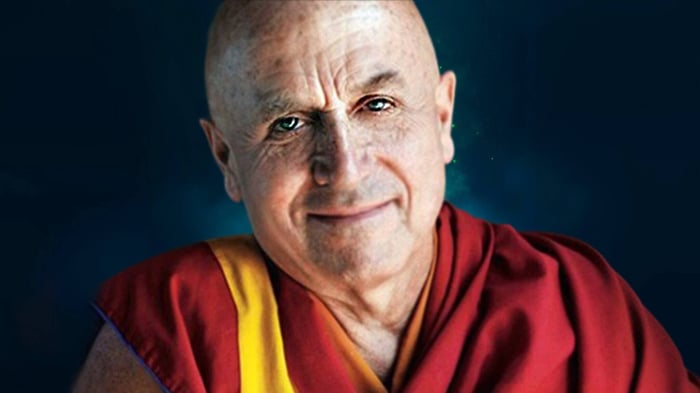
Matthieu Ricard used to be a molecular biologist. A brilliant scientist with a PhD and a career all mapped out. Then he dropped everything and became a monk. 50,000 hours later, he's a living legend.
When the researchers scan his brain, they have to recalibrate their scales. His left prefrontal cortex, the brain's happiness center, lights up like a Christmas tree. The activity is so high that it literally falls outside the normal human range.
But it gets even better. They test his startle reflex, that involuntary reaction when something makes you jump. In ordinary people it's uncontrollable. In Ricard? Nothing. His nervous system is so well trained that he controls even his most primitive reflexes.
The researchers ask him what it feels like. His answer: "Like permanently swimming in a warm bath of love and bliss."
The bitter pill for us ordinary mortals
Now comes the part that hurts. Researchers have calculated how long it would take a Westerner to reach these states. The answer? 15,000 to 20,000 hours of focused meditation.
That's 5-6 hours a day. Every day. For 10 years. Without a break. Without Netflix. Without "just quickly checking Instagram."
And even then there's no guarantee. Because our modern brains are "messed up." The constant flood of dopamine from social media has wrecked our neurochemistry. We're neurological junkies, hooked on the next dopamine kick.
A Harvard study tried 8 weeks of meditation with beginners. The result? Minimal changes. A little less stress, a little more gray matter. Compared with the monks? A bad joke.
The Default Mode Network: your biggest enemy
This is where it gets really fascinating. Yale researchers discovered the real reason we can't find peace: the Default Mode Network. This brain network is like a radio that never switches off. It produces 60,000 thoughts a day. Most of them garbage.
"What do other people think of me?" "Did I lock the door?" "That embarrassing moment 10 years ago..." Sound familiar?
In the monks, this network is almost completely silent. Silence. Real silence. No voice in the head. No inner critic. Just pure awareness.
The scientists could hardly believe it. These men have literally switched off their egos. They exist in a state that we only experience for a few seconds during orgasm or in extreme flow states. Except that they live in it permanently.
The moment that changed everything...
Research on brainwave entrainment (the brain's ability to align itself with external frequencies) has existed since the 1970s. What has changed is our understanding of how the brain responds to acoustic frequencies.
Over decades, scientists have documented that certain frequencies really can influence brainwaves. Binaural beats and isochronic tones are real, well-researched technologies.
And here's the key point: we took the findings from all these studies (the documented gamma explosions in the monks, their theta-alpha coupling, the measured frequency patterns of their states of enlightenment) and reproduced them in our lab and recording studio.
The technology that saves you 40 years of meditation
Months of work. Hundreds of test runs. Countless fine adjustments. The result is Buddha Mind, a 40-minute frequency journey that makes these expanded states of consciousness accessible to everyone. Without 40 years of meditation. Without a monastery. Without giving up your everyday life.
Buddha Mind uses the exact frequency patterns from the EEG studies: gamma waves around 40 Hz for heightened awareness, the theta range around 4-8 Hz for deep meditation, and alpha waves at 8-12 Hz for relaxed clarity. Everything is precisely tuned to work together and gently guide your brain into these extraordinary states.
What happens in your brain
Here's what Buddha Mind does to your brain in 40 minutes:
Minutes 1-10: Theta waves (4-8 Hz) ramp up. The noise of your thoughts gets quieter. Your inner critic falls silent.
Minutes 10-20: Alpha waves (8-12 Hz) synchronize. Deep relaxation sets in. You feel as if you're floating.
Minutes 20-30: Gamma activation begins. 40 Hz, then 80 Hz. Suddenly everything becomes clearer. Your perception sharpens.
Minutes 30-40: Complete frequency coupling. Theta, alpha and gamma in perfect harmony. A state monks call "satori": spontaneous enlightenment.
Buddha Mind is a technological masterpiece that combines SEVEN different consciousness technologies:
- Isochronic tones - the most powerful pulses for deep brain stimulation
- Binaural beats - precise frequency synchronization for both hemispheres of the brain
- Harmonic Box X - a proprietary technology for amplified resonance
- Monaural beats - direct frequency effect without needing separate headphone channels
- MDR technology - Multi-Dimensional Resonance for profound shifts in consciousness
- 3D effect technologies - spatial sound processing that puts your brain into an immersive state
- Authentic Himalayan sound elements - original recordings of temple bells, singing bowls and sacred instruments
Each of these technologies amplifies the others. It's like the difference between a single instrument and a full symphony orchestra.
Buddha Mind is based on real EEG data from real monks. Every frequency was extracted with millisecond precision from thousands of hours of brain scans. The acoustic atmosphere? Straight from Tibetan temples. The singing bowls? Specially chosen for the perfect frequency signature.
The uncomfortable truth
Let me tell you something the meditation gurus won't: most of us will never have the time to meditate for 20,000 hours.
We have jobs. Families. Obligations. Netflix series we "have to" finish... We're not monks, and we probably never will be.
But does that mean we have to go without expanded states of consciousness? Without inner peace? Without the experience of transcendence? No. Not anymore. Not with Buddha Mind.
40 years of monk training. Compressed into 40 powerful minutes. The neurological keys to enlightenment, directly available to your brain.
No trip to the Himalayas. No stay in a monastery. No decades of practice. Just you and the frequencies that can change everything.
Yours, Marko C. Lorenz
FAQs
What are gamma waves and why are they so high in monks?
Gamma waves (25-100 Hz) are the fastest brainwaves and are associated with the highest levels of awareness, aha moments and spiritual experiences. Tibetan monks with more than 10,000 hours of meditation practice show up to 30 times more gamma activity, because decades of practice have caused neuroplastic changes in their brains. These permanent changes make states of consciousness possible that don't occur in ordinary people.
How long would I have to meditate to reach the brain states of the monks?
Scientific studies show that significant lasting changes in the brain only appear after about 15,000-20,000 hours of focused meditation. That's equivalent to 5-6 hours of daily practice over 10 years, without interruptions and without the distractions of modern life. The Harvard study showed that 8 weeks of normal meditation only brings about minimal changes.
What is the Default Mode Network and why does it matter?
The Default Mode Network (DMN) is a brain network responsible for our inner monologue, self-perception and ego. It produces up to 60,000 thoughts a day. In 2011, Yale researchers discovered that in meditating monks the DMN almost completely "switches off," which leads to real mental stillness, a state ordinary people only experience for a few seconds.
Does brainwave entrainment really work scientifically?
Yes, brainwave entrainment has been scientifically studied since the 1970s. The brain has a natural tendency to align itself with external rhythmic stimuli (the frequency following response). When you present your brain with certain frequencies, it begins to mirror them. This is measurable and reproducible, which is why technologies like binaural beats and isochronic tones work.
Can anyone reach the monks' states of consciousness?
With traditional meditation, it's almost impossible for people in the West to reach these states, because constant digital stimulation has wired our brains differently. Buddha Mind, however, uses frequency technology to guide the brain directly into these states. While the effects aren't identical to 40 years of meditation, it still gives you access to expanded states of consciousness that would otherwise be out of reach.
Who is Matthieu Ricard and why is he called the "happiest person"?
Matthieu Ricard is a French molecular biologist who gave up his career and became a Buddhist monk. With more than 50,000 hours of meditation experience, his brain scans showed the highest activity ever measured in the left prefrontal cortex, the brain's "happiness center." His gamma wave activity was so high that researchers had to recalibrate their measurement scales.
How long is a Buddha Mind session?
A Buddha Mind session lasts 40 minutes and guides you through four precisely calibrated phases: theta activation (minutes 1-10) for a quiet mind, alpha synchronization (10-20) for deep relaxation, gamma activation (20-30) for heightened clarity, and complete frequency coupling (30-40) for transcendent states.
Are the studies on meditating monks real?
Yes, the studies are real and peer-reviewed. The most important one is the 2004 PNAS study by Antoine Lutz and Richard Davidson at the University of Wisconsin, which documented elevated gamma activity in Tibetan monks. Other major studies come from Sara Lazar (Harvard), Judson Brewer (Yale) on the Default Mode Network, and numerous follow-up studies that confirm these findings.