
About 20% of all adults procrastinate chronically. It isn't laziness, and it isn't a lack of discipline. Their brain runs on a pattern that makes putting things off the default response. This article shows you what happens neurologically, why the usual tips so often fall flat, and how you can overcome procrastination by tackling it where the problem starts: in your nervous system.
Monday, 9:47 a.m. Your brain has other plans.
You're staring at the open file. The presentation has been due for three days. You know it. Your calendar knows it. Your boss knows it. And still you open a new tab, check the news, tidy your desk, grab your third coffee. At some point you google "tips to stop procrastinating" and land on an article that tells you to just "get started." Thanks for nothing.
Sound familiar?
The frustrating thing about most advice on chronic procrastination is that it treats procrastination as a motivation problem. Set goals. Make to-do lists. Reward yourself. Sounds logical, yet it doesn't work for the people who need it most. And there's a reason for that which runs deeper than any time management method.
Procrastination has nothing to do with a character flaw. It's a neurological pattern.
Overcoming procrastination starts in the brain
The causes of procrastination lie in the architecture of your nervous system rather than in your character. In recent years, neuroscientists have drawn a pretty clear picture of what happens in the brain when you put things off. And it has little to do with laziness.
Amygdala vs. prefrontal cortex: an unfair fight
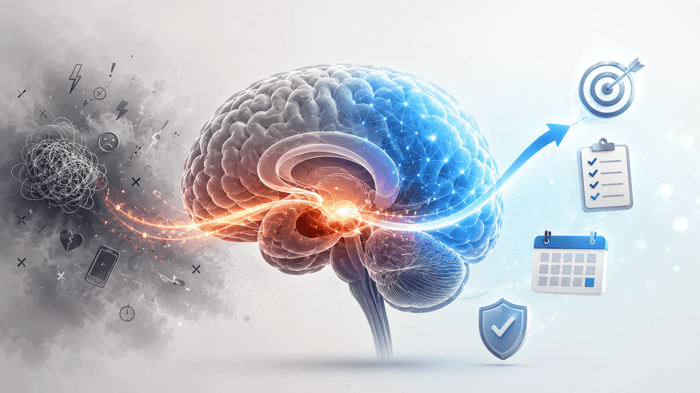
The brains of chronic procrastinators show a striking pattern: a hyperactive amygdala and a comparatively underdeveloped prefrontal cortex. The amygdala is your emotional alarm system. It judges situations as threatening or safe in a split second. The prefrontal cortex is your rational decision-maker, in charge of planning, impulse control and long-term thinking.
In procrastinators, the amygdala regularly wins this fight. When you sit down in front of an unpleasant task, your emotional brain fires off a signal: Danger. Unpleasant. Avoid. And it does so before your prefrontal cortex even gets a chance to push back. Psychologist Tim Pychyl of Carleton University in Ottawa summed it up in his research: procrastination is primarily a problem of emotion regulation, not of time management.
Procrastination is a failure of emotion regulation, not a time management problem. The emotional brain systematically overrules the rational decision-maker. That's why calendar apps and to-do lists alone won't help if the neurological foundation is missing.
The Association for Psychological Science (APS) confirmed this connection in a comprehensive review: procrastination is closely tied to the ability to regulate negative emotions. If a task makes you feel anxious, bored or overwhelmed and you can't process those feelings well, you dodge it. Laziness has nothing to do with it. Your brain simply picks the short-term escape route.
Temporal discounting: why "later" always wins
There's a second neurological mechanism driving procrastination: temporal discounting. Your brain systematically values future rewards less than immediate ones. A study published in 2024 in Scientific Reports demonstrated this link in everyday life for the first time: the more strongly a person discounts future rewards, the more they procrastinate in real life.
In plain terms: your brain does the math, and the math goes like this. Netflix now = instant reward. Finished presentation = reward in three days, maybe. For your limbic system, that isn't even a decision. It runs on autopilot.
Piers Steel of the University of Calgary, one of the world's leading procrastination researchers, showed in his 2007 meta-analysis that impulsivity is the single strongest predictor of procrastination. Stronger than perfectionism, stronger than anxiety, stronger than a lack of motivation. And impulsivity is regulated largely by the prefrontal cortex.
What procrastination really costs you
In the moment, procrastination feels harmless. There's always tomorrow, right? The research data paint a different picture, though. The GitNux Report 2026 compiled 134 statistics on the effects of procrastination. Some of them are pretty sobering:
| Effect | Value |
|---|---|
| Daily productivity drops by | 15% |
| More errors in work done under pressure | +40% |
| Missed project deadlines more often | +35% |
| Lower career satisfaction | -22% |
| Promotion delayed on average by | 6 months |
| Higher risk of business failure | +22% |
Source: GitNux Procrastination Statistics Report 2026, based on 134 analyzed statistics.
And those are just the professional costs. In a 2022 study with 732 participants (published in Frontiers in Psychology), Alexander Rozental of Uppsala University showed that severe procrastination goes hand in hand with more mental and physical health problems: sleep problems, stress, and guilt that piles up like unanswered emails.
Then there's how common it is. According to Steel's meta-analysis, about 50% of all students procrastinate consistently and chronically. Among adults, the rate is around 20%. The procrastination clinic at the University of Münster, one of the few specialized facilities in the German-speaking world, reports growing demand.
Sounds like a lot? Do the math: if you're just 15% less productive and project that over a full working year with 8-hour days, you lose around 300 hours a year. That's almost eight full working weeks. Simply gone.
5 strategies against procrastination that actually work
If procrastination is a neurological pattern, you need strategies that work on a neurological level. The following five approaches have one thing in common: they're backed by research and go beyond "just make a to-do list." Here are the best procrastination tips that really make a difference:
The 2-minute threshold: start before your brain can say "no"
Your prefrontal cortex needs a nudge to take control back from the amygdala. The trick: instead of telling yourself "I'm going to do the whole presentation now," say "I'll open the file and write one sentence." Two minutes, nothing more. Research shows that resistance to a task is highest before you start. Once you're in it, a different mode takes over. One Reddit user in a procrastination forum summed it up like this: "Start doing and stop planning." Sounds simple. From a neurological point of view, it's pretty smart.
Name your emotions instead of pushing them away
If procrastination is an emotion regulation problem, it helps to identify the emotion that's blocking you right now. Is it fear of the outcome? Boredom? Overwhelm? Pychyl's research shows that simply naming the emotion measurably reduces amygdala activity. Your brain switches from pure reaction mode into a reflective mode. In practice: the next time you're about to procrastinate, pause for a moment and ask yourself: What exactly am I feeling right now when I think about this task? Often that alone is enough to break the automatic pattern.
Break tasks down (the right way)
"Do my taxes" isn't a task. It's a project with 15 separate steps. Your brain sees that mountain and switches into avoidance mode. The solution: break every big task into steps so small that they no longer trigger an emotional reaction. "Get the pay slips out of the folder" doesn't cause panic. "Do my taxes" does. According to the AOK (a major German health insurer) and various university guides in the German-speaking countries, setting micro-goals is one of the most effective behavioral strategies against chronic procrastination.
Commitment devices: make the way back harder
A commitment device is a commitment you make before the avoidance impulse kicks in. According to the GitNux Report 2026, commitment devices increase task completion rates by 55%. It could be a work session scheduled with a colleague, a public deadline or an app that locks your phone. The point is that you take the choice away from your future, procrastinating self. Sounds harsh. But it works because it outsmarts temporal discounting. The reward for not procrastinating (the social commitment) becomes something you feel right away instead of something far off in the future.
Self-compassion instead of self-criticism
This may sound surprising, but Pychyl and his team demonstrated that people who forgive themselves after a procrastination relapse procrastinate less the next time. The mechanism makes sense once you understand the neurology: self-criticism activates the amygdala (threat!), which reinforces the avoidance loop. Self-compassion calms the emotional system and gives the prefrontal cortex room to take the lead again. So if you procrastinated today, the worst possible next step is to beat yourself up about it.
These five strategies address the psychological and behavioral side of procrastination. They work, and the data show it. According to GitNux, cognitive behavioral therapy (CBT) reduces procrastination by up to 50%. The question is: what do you do when the neurological foundation itself is the problem?
The neurological shortcut: when behavioral strategies alone aren't enough
All of the strategies above assume that your prefrontal cortex is strong enough to take the lead. But what if that's exactly the weak spot?
Imagine someone telling you "just run faster" while your leg is in a cast. The instruction isn't wrong. It just doesn't fit your starting point. And with chronic procrastination, the starting point is often a neurological one: a prefrontal cortex with too little activity and an amygdala with too much.
This is exactly where it gets exciting for me personally. I've been working with brainwave entrainment for more than 15 years, exploring how brain states can be influenced in a targeted way. And procrastination is a topic where the link between brainwaves and behavior is especially easy to see.
Beta waves in the 14-18 Hz range have been shown to increase activity in the prefrontal cortex, which is exactly the region that fires too little in procrastinators. SMR waves (sensorimotor rhythm) at 12-15 Hz additionally boost your motor readiness to act. The bridge between "I want to do this" and "I'm doing it now" gets stronger at the neural level.
That's exactly why I developed the Procrastination Killer. It's a bundle with two components: a frequency session that activates the prefrontal cortex and calms the overactive amygdala, and Neuro Suggestions that work on the subconscious in parallel by replacing deep-seated avoidance patterns and linking tasks with reward instead of threat.
📊 How the Procrastination Killer works on a neurological level
Increases activity in the prefrontal cortex, strengthens impulse control and action planning
Boosts motor readiness to act, closes the gap between intention and action
Replaces avoidance patterns, links tasks with reward instead of threat
⚡ The approach
The frequencies create the neurological foundation. The Neuro Suggestions change how you emotionally evaluate tasks. Together they address both sides of the procrastination mechanism: the cognitive and the emotional.
An honest note at this point: the frequencies can speed up and deepen the process, but they can't make the behavior change for you. The five strategies above still matter. The Procrastination Killer creates the conditions for those strategies to work at all, because it puts your brain in a state where the prefrontal cortex actually plays along.
You know what you need to do, but you still don't get started. You've tried behavioral strategies and they only work for a short while. You sense that the problem goes deeper than a lack of discipline.
You only put things off now and then (that's human and normal). Or if you're dealing with clinical depression or a severe anxiety disorder, where professional therapeutic support is the right first step.
The Procrastination Killer will be released on May 26, 2025. If you want to be among the first to try it, you'll find all the details on the product page.
Frequently asked questions about procrastination
Is procrastination a mental illness?
Procrastination isn't a mental illness in its own right, but it can be a symptom or side effect of depression, ADHD or anxiety disorders. The procrastination clinic at the University of Münster distinguishes between occasional procrastination (normal, human) and chronic procrastination, which significantly impairs well-being and performance. If putting things off weighs on you constantly and you can't get out of it on your own, professional support makes sense.
Why do I keep procrastinating despite good intentions?
It comes down to the interplay between the amygdala and the prefrontal cortex. Your emotional brain responds to unpleasant tasks with an avoidance impulse that fires faster than your rational decision-maker can counter it. Temporal discounting amplifies the effect: immediate relief weighs more heavily in the brain than future benefit. Good intentions are products of the prefrontal cortex, but in the decisive moment the amygdala often wins.
Can brainwave frequencies help with procrastination?
Beta waves in the 14-18 Hz range have been shown to increase activity in the prefrontal cortex, which is responsible for impulse control and action planning. SMR waves at 12-15 Hz boost motor readiness to act. These frequencies can create the neurological foundation for better self-regulation. They don't replace behavior change, though. They create the conditions for behavioral strategies to work better.
How many people are affected by procrastination?
About 20% of all adults procrastinate chronically, according to a meta-analysis by Piers Steel (University of Calgary, 2007). Among students, the rate is much higher: 50% procrastinate consistently, 75% describe themselves as procrastinators, and up to 95% report procrastinating occasionally. A study on solvingprocrastination.com gives a comprehensive summary of the peer-reviewed research.
Your next step
Overcoming procrastination isn't a sprint. It's a process that happens on two levels at once: the behavioral level (the five strategies above) and the neurological level (your brain's ability to regulate impulses and initiate action).
Pick the one of the five strategies that speaks to you most and try it this week. Just one. If you notice that the behavioral level alone isn't enough and you want to tackle the neurological side as well, take a look at the Procrastination Killer. It's available from May 26.
And if you're reading this article right now to put off another task (I see you): close the tab. Open the file. Write one sentence. Two minutes. Your prefrontal cortex will thank you.
Stop procrastination where it starts
The Procrastination Killer combines targeted beta and SMR frequencies with Neuro Suggestions to build the neurological foundation for getting things done. Available from May 26, 2025.