
You read a paragraph, get to the bottom and realize that not a single word has stuck. You scroll back up and read it again. Same result. Your head feels like someone stuffed it with cotton wool. Welcome to the brain fog test, which shows you in just a few minutes whether your brain really is in a fog, and what you can do about it.
Why most people don't know they have brain fog
Here's the thing that surprised me during my research: most people with brain fog don't even recognize it as such. They think that's just what a normal Tuesday afternoon feels like. Or Wednesday morning. Or pretty much every day after 2 pm.
The tricky thing about mental fog is that it creeps in gradually, over weeks and months rather than overnight. At some point you consider this state normal, simply because you've forgotten what a clear head feels like. You compensate with coffee, with to-do lists, with the third alarm on your phone. And you still wonder why everything is so exhausting.
I was at that point myself. I thought I didn't need a brain fog test because I was functioning. Being productive. Getting my stuff done. Then I looked at the research and realized that functioning and thinking clearly are two completely different things. You can drive with the handbrake on and still arrive. It just takes longer and costs you a lot more energy.
If you want to understand the neurological background of brain fog in detail, check out our in-depth article on brain fog causes from a neurological perspective. Here we're dealing with the practical question: Am I affected, and if so, how badly?
Brain fog test: the 7 warning signs almost everyone overlooks
Before you take the actual brain fog self-test further down, here's a quick preliminary check. Go through the following seven points and count how many make you nod along.
You read texts several times without retaining them
And it's not because the text is complicated. Your brain takes in the information, but it slips right back out. Like water through a sieve.
You lose your train of thought mid-sentence
You know exactly what you wanted to say. And then it's gone. The word is on the tip of your tongue, but your brain just won't deliver it.
Your head feels "cottony"
No pain, no specific symptom. More of a vague feeling, as if there were a pane of frosted glass between you and the world. Thoughts arrive with a delay.
Coffee only helps for a short while
One cup used to be enough. Now you need two or three, and the effect lasts maybe 45 minutes. After that, everything sags again.
Simple decisions drain your energy
What to eat? Which movie to watch? Which email to answer first? Things you'd normally decide in seconds feel like project management.
You're already tired in the morning
You slept eight hours, but you wake up feeling like you got four. Your brain just can't get going. The fog is already there before the day has even started.
You're functioning, but everything feels muted
Get up, work, function, sleep, repeat. You get your stuff done, but it feels like you're doing it all through a thick wall of fog. No flow, no momentum, no "yes, this is going well."
Nodded along to three or more points? Then keep reading. Because what you're experiencing has a measurable neurological cause. And there's a way out.
What happens in your brain when the fog rolls in
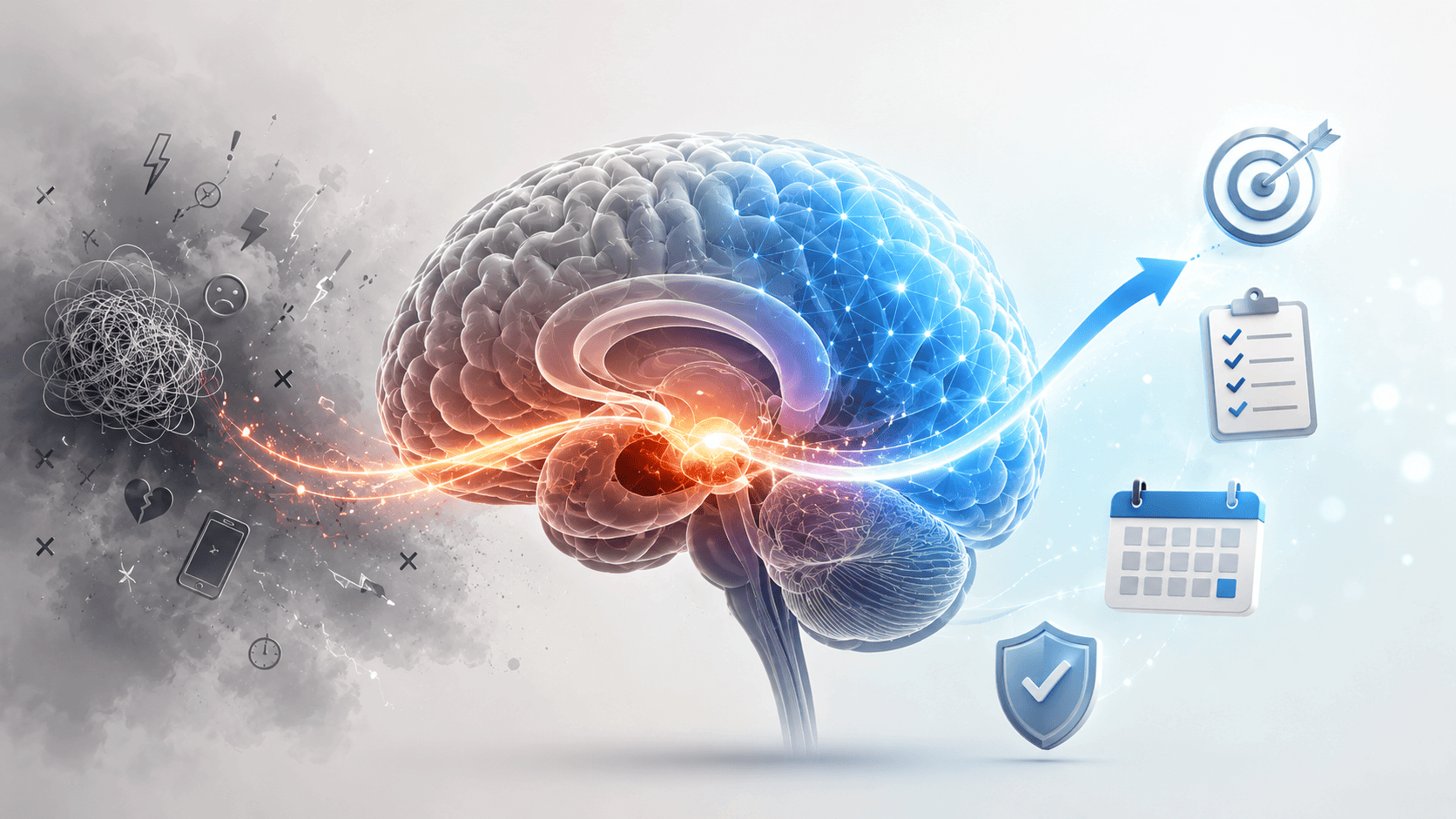
Brain fog isn't a character flaw or a sign of laziness. Today, neuroscientists can make this state visible in an EEG, and what they find is consistent: your brain has a frequency imbalance.
Think of your brain as an orchestra. Different frequency bands play different instruments. When your head is clear, they all play together, in time and in tune with each other. With brain fog? The slow instruments play far too loudly, and the fast ones can barely be heard.
The frequency imbalance behind brain fog
Specifically, this is what it looks like in the EEG: too many theta waves (4-7 Hz) keep your brain in a twilight state. They're actually responsible for daydreaming and the transition into sleep. At the same time, there's a lack of beta waves (13-30 Hz), which are responsible for active, clear thinking. And the gamma activity at 40 Hz that makes thoughts come together instead of falling apart? Practically nonexistent.
Theta waves dominate, beta activity is muted, gamma almost absent. Thoughts are scattered, slow and disconnected.
Theta in the normal range, beta active, gamma bursts present. Thoughts mesh together and focus feels effortless.
Researchers at MIT (Tsai Lab, 2024) have shown something exciting: targeted 40 Hz stimulation activates mechanisms in the brain that clear away metabolic waste and resynchronize neural networks. Think of it like defragmenting your hard drive. The data is still there, it just gets put back in the right order.
An EEG study (published in Frontiers in Human Neuroscience, 2022) showed that 15 Hz binaural beats measurably improve the functional connectivity of brain networks during mental fatigue. The participants reported significantly fewer brain fog symptoms after the stimulation.
Brain fog isn't a willpower problem. It's a measurable frequency imbalance in your brain. Your head is stuck in a state it can't free itself from with coffee and willpower alone. The good news: this imbalance can be corrected in a targeted way.
Brain fog self-test: how to find out how badly you're affected
The seven warning signs above give you a first orientation. The following brain fog test goes deeper. It helps you assess whether you're mildly, moderately or severely affected and, based on your result, shows you which next step makes sense for you.
The test takes about 3 minutes. Answer the questions spontaneously, without thinking too long. Your first impulse is usually the most honest one.
Important note: This self-test doesn't replace a medical diagnosis. It's based on the typical brain fog symptoms described in the neuroscientific literature. If your symptoms are persistent or severe, please see a doctor.

What you can do with your result
No matter where you land in the test, the result isn't a verdict. It's a starting point. And for every level there are concrete things you can do.
📊 Your result at a glance
Improve your sleep hygiene, cut down on screen time before bed, move regularly. Lifestyle changes are often enough.
Lifestyle measures alone often aren't enough anymore. This is where targeted brainwave entrainment can make the difference, because it works directly on the frequency imbalance.
A medical check-up is recommended to rule out organic causes. Alongside that: targeted frequency support to get your brain out of the theta excess.
⚡ The key point
Willpower doesn't change brain frequencies. When your brain is stuck in theta excess, you need an impulse that kick-starts beta and gamma activity again. That's exactly what Out of the Fog was developed for.
What helps at all three levels, and what the research on getting rid of brain fog shows: your brain needs a kind of reset. Something that dials down the overactive theta waves and wakes up the dormant beta and gamma ranges.
That's exactly what Out of the Fog does. In 30 minutes, a three-stage frequency protocol guides your brain through three phases:
🔬 The three-stage protocol behind Out of the Fog
A gentle start: reducing theta excess and creating the first bit of clarity. Your brain is carefully brought out of its twilight state.
Building mental sharpness. Beta waves are gradually stimulated, making clear, active thinking possible.
Cognitive integration. Gamma pulses help thoughts come together again. Based on MIT research (Tsai Lab, 2024) on neural synchronization.
WHY ISOCHRONIC TONES
Out of the Fog mainly uses isochronic tones instead of binaural beats. The reason: they produce the strongest measurable entrainment effect on the cortex and don't require headphones (although headphones are recommended). For brain fog this is crucial, because the brain needs a strong impulse to get out of the theta excess.
I've been using this frequency myself for a few weeks now. Even though I thought I didn't need it. The difference is noticeable: thoughts connect faster, writing flows more easily, and that subtle afternoon sluggishness has decreased significantly. No miracles, but a noticeable difference.
And no, this isn't a placebo argument. The mechanics behind it can be measured in the EEG. If you're interested in the neurological causes of brain fog in detail, you'll find the full scientific breakdown in our other article.
Frequently asked questions about the brain fog test
Is brain fog a disease?
Brain fog isn't a diagnosis in its own right. It's a cluster of symptoms describing a state of reduced cognitive performance with concentration problems, word-finding difficulties and slowed thinking. The causes can vary: lack of sleep, chronic stress, inflammatory processes, hormonal changes or even long COVID. In the EEG, brain fog typically shows up as theta overactivity combined with beta and gamma underactivity.
Can an online test reliably detect brain fog?
An online self-test doesn't replace a medical diagnosis or an EEG measurement. But it can help you classify your brain fog symptoms systematically and get a sense of whether and how strongly you're affected. See the result as a guide rather than a medical verdict. If your symptoms are persistent or severe, I always recommend seeing a doctor.
What does 40 Hz gamma stimulation have to do with brain fog?
Researchers at MIT (Tsai Lab, 2024) have shown that targeted 40 Hz stimulation activates mechanisms in the brain that clear away metabolic waste and synchronize neural networks. In brain fog, exactly this gamma activity is reduced. 40 Hz bursts can promote cognitive integration and reduce the typical feeling of scattered, disconnected thoughts. A study (2024) also showed that 40 Hz binaural beats can improve long-term memory.
How often should I listen to Out of the Fog?
For the best effect: daily, 30 minutes, with your eyes closed. Many users report noticing a clear "fog lift" after about 10 minutes. For lasting results, I recommend using the frequency regularly for at least 2-3 weeks so the new neural patterns can stabilize.
Your next step: out of the fog
If you've read this far, you now know three things: brain fog is real, it's measurable, and it's not your fault. Your brain is stuck in a frequency imbalance that can't be resolved with willpower alone.
Take the brain fog test, find out where you stand, and then decide what the right next step is for you. For many people, this is the moment they realize: I don't have to keep going like this. There's a way that tackles the actual problem.
30 minutes against the fog in your head
Out of the Fog is a three-stage frequency protocol that gently brings your brain out of theta excess, builds up beta activity and clears the cognitive fog with gamma pulses. 30 minutes, based on current MIT research, measurable in the EEG.