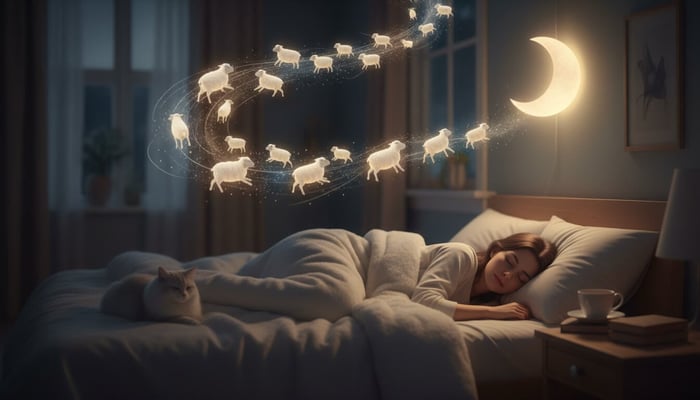

You're lying in bed, staring at the ceiling, and you just can't fall asleep. So you try the oldest sleep trick in the world: counting sheep. One, two, three... at thirty-five you notice you're still wide awake. At seventy you wonder whether you lost count a while ago. And at one hundred and three you suddenly find yourself thinking about your "beloved" mother-in-law's upcoming visit, or whether your Amazon package will really arrive tomorrow.
If it's any comfort, you're not alone. Around 43 percent of Germans regularly struggle with sleep problems, and plenty of them have tried the woolly four-legged route at some point. The problem (and I bet you can confirm this): counting sheep doesn't work. That's not just a subjective impression. It's the result of a study from the University of Oxford. Luckily, there are methods that actually work, and they're just as well backed by science.
What research really says about counting sheep
Before I get to what can really help you fall asleep, let's quickly clear up a myth that has stubbornly survived for generations. The idea behind counting sheep sounds logical at first: a monotonous, boring activity should tire out your brain and calm your thoughts. So much for the theory.
Sleep researchers Allison Harvey and Suzanna Payne from the University of Oxford wanted to know more and ran a controlled study in 2002 to find out which sleep techniques actually work. They divided 50 people with trouble falling asleep into three groups. The first group was asked to imagine relaxing scenes: a waterfall, a quiet beach, a walk in the woods. The second group was asked to distract themselves, for example by counting sheep. The third group got no instructions at all. The result surprised even the researchers: the visualizers fell asleep about twenty minutes faster than usual on average. And the sheep counters? They actually took longer than usual to fall asleep.
Why your brain can't switch off while counting sheep
So why doesn't counting sheep work, even though it's so wonderfully boring? The answer lies in a part of your brain called the prefrontal cortex. This front section of the brain handles conscious thinking: planning, calculating, analyzing. That's exactly the opposite of what you need to fall asleep. When you count sheep, you activate this area. You have to keep the numbers in your head, concentrate, maybe even correct yourself when you get mixed up. So your brain is working when it should be powering down.
To fall asleep, though, the prefrontal cortex needs to switch into rest mode, as numerous neuroimaging studies show. That also explains why visualization works so much better. When you picture a dreamy white beach with palm trees, you activate other brain areas. Images like that hold enough of your attention to push out rumination, but they don't challenge your brain cognitively. That's the perfect state for falling asleep.
Three methods that really work, according to sleep research
At a glance:
- Guided visualization: relaxing scenes activate the right brain areas
- 4-7-8 breathing: activates the nervous system for relaxation
- Frequency-based sleep aids: gently synchronize your brainwaves toward sleep
The Oxford study didn't just show that counting sheep is pretty useless for falling asleep. It also pointed to a clear alternative, and luckily that one is just as easy to use, without being as tiring and as dull as counting sheep. Here are three methods that are backed by science and that you can try tonight.
Method 1: Guided visualization
Instead of making sheep jump over a fence, picture a place where you feel completely relaxed. That could be a beach at sunset, a forest clearing in summer or your favorite spot from childhood. The key is to go into detail. How does the sand feel under your feet? What sounds do you hear? What does the air smell like? The more senses you involve, the deeper your brain sinks into this inner world, and the less room is left for circling thoughts. The participants in the Oxford study who used this technique fell asleep more than twenty minutes faster than without any aid.
Method 2: The 4-7-8 breathing technique
This method originally comes from yoga and was popularized by the American physician Dr. Andrew Weil. The principle is simple: breathe in through your nose for four seconds, hold your breath for seven seconds, then breathe out slowly through your mouth for eight seconds. What happens in the process is fascinating. The long exhale activates your parasympathetic nervous system, the part of your nervous system responsible for relaxation. Your heart rate slows, your blood pressure drops, and your body gets the signal that it's safe to let go. Two or three rounds are often enough to feel noticeably calmer.
Method 3: Frequency-based sleep aids
While the first two methods rely on conscious mental techniques, this approach takes a different route. Certain sound frequencies have been shown to influence brainwaves and gently guide the brain toward sleep. Delta frequencies in the range of 0.5 to 4 Hz are especially well researched. That's exactly the frequency range your brain is in during deep sleep. Studies show that brainwave entrainment, meaning the targeted synchronization of brainwaves through acoustic stimuli, can shorten the time it takes to fall asleep and improve sleep quality. The advantage: you don't have to do anything actively. You can simply let the sounds carry you. Products like Neuro-Sleep Therapy combine these frequencies with guided relaxation techniques and hypnosis elements into a complete sleep system.
Bottom line: Forget the sheep, your brain needs something else
Counting sheep is one of those sleep tips that stubbornly hang around even though they've been shown not to work. If you count sheep, you activate exactly the brain regions that should be powering down for sleep. No wonder you're still lying awake after a hundred sheep and now also know everything you have to get done tomorrow.
The good news for anyone who struggles to fall asleep is that there are alternatives that actually work. Whether you go for guided visualization, try the 4-7-8 breathing technique or use frequency-based methods, all of these approaches have one thing in common: they work with your brain instead of against it. They help your nervous system switch into relaxation mode instead of boring it with monotonous counting exercises.
So if you're lying awake again tonight and the thought of sheep pops up, remember the Oxford study. Then picture a place you'd love to be right now instead. That could be a deserted beach in the Maldives, a cabin in the mountains or, if you're from the right generation, a cozy evening in the Shire. Take a deep breath or let the right frequencies carry you into sleep. Your brain will thank you. And the thoughts about your mother-in-law can safely wait until tomorrow.
Yours, Marko C. Lorenz
FAQs
Does counting sheep help you fall asleep?
No, counting sheep doesn't help you fall asleep. A 2002 study from the University of Oxford even suggests the opposite: participants who counted sheep took longer to fall asleep than the control group, who used no technique at all. The reason is that counting is a cognitive task. It activates your brain instead of letting it wind down.
Why doesn't counting sheep work?
When you count sheep, you activate your prefrontal cortex, the part of your brain responsible for conscious thinking, planning and calculating. That's exactly the area that needs to power down for you to fall asleep. On top of that, the monotonous counting task isn't demanding enough to effectively push out rumination and worries.
What actually helps you fall asleep?
Three methods in particular are backed by science. First, guided visualization, where you picture a relaxing place in your mind. Second, the 4-7-8 breathing technique, which activates your parasympathetic nervous system and shifts your body into relaxation mode. Third, frequency-based sleep aids that gently synchronize your brainwaves toward sleep.
How long should it take to fall asleep?
Healthy adults usually fall asleep within 10 to 20 minutes. If you regularly lie awake for more than 30 minutes, you may have trouble falling asleep. On the other hand, if you're out the moment your head hits the pillow, you might be sleep deprived.
Where does the tradition of counting sheep come from?
Nobody knows its exact origin, but there are two popular theories. The first says that shepherds used to count their sheep before going to bed to make sure none had gone missing, and often fell asleep while doing it. The second theory points to the peaceful, woolly look of sheep, which stands for calm and a sense of safety.