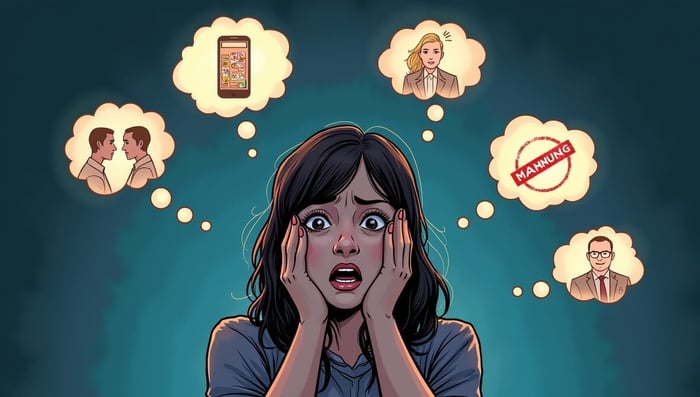

Do you know that feeling when you go from 0 to 100 without knowing why? Your partner says the wrong word, a colleague gives you a funny look, your mother makes a harmless remark, and suddenly something explodes inside you. Your heart pounds, your hands shake, your voice gets louder. And before your mind even grasps what's happening, you've said or done something you'll regret later. Your partner just stands there, baffled. The mood hits rock bottom. And you? You don't even really know why. It just happens, automatically, like a reflex you can't control.
Your body warns you 90 seconds in advance. In 2025, researchers at Stanford Medicine found that emotional triggers set off measurable neurological patterns long before you lose control. The only question is whether you recognize the signals in time.
What happens in your brain when you get triggered
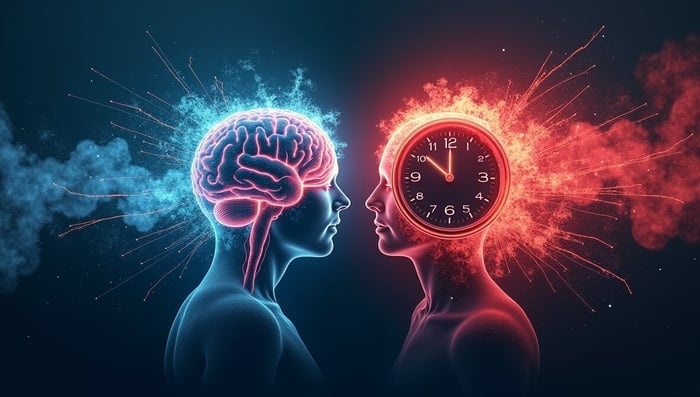
Imagine an overzealous security guard sitting in your head. His job? Protecting you from danger. The problem is that this guard can't tell the difference between a real threat and a harmless remark. And once he sounds the alarm, there's no going back.
This guard has a name: the amygdala. It's an almond-shaped area deep in your brain that's responsible for your emotional reactions. And when you get triggered, it takes command in just 200 milliseconds.
The 200-millisecond moment: when the amygdala takes over
200 milliseconds. That's the blink of an eye, a fifth of a second. In that time, your amygdala has already decided that danger is imminent, released stress hormones and put your body on high alert. Your conscious mind? It only catches up seconds later and wonders: "What just happened?"
In a groundbreaking 2025 study, Stanford Medicine measured exactly this process. The researchers were able to show that a single brief trigger stimulus, even a harmless puff of air, sets off long-lasting changes in brain activity. These changes last hours, not just seconds. Your brain stores these patterns like an overcautious security system that springs back into action at every similar signal.
Here's how it plays out:
0-50 milliseconds: Your amygdala registers a potential trigger and sounds the alarm before you consciously notice anything.
50-200 milliseconds: Stress hormones like cortisol and adrenaline flood your body. Your heart starts racing.
200-500 milliseconds: Your prefrontal cortex (the part responsible for reason and self-control) is effectively "taken offline."
From 500 milliseconds on: You react. Fight, flight or freeze. Your survival mode has taken over.
In this state, you're literally not yourself anymore. It's as if someone else has taken control.
The gatekeeper cells: why your brain makes the wrong call
But why does your amygdala get it wrong so often? Why does it treat a harmless remark as a threat?
In 2024, researchers at UC Davis made an astonishing discovery: the amygdala contains special cell types that work like gatekeepers. They control which signals get through and which are blocked. These FOXP2-expressing cells decide in milliseconds: "Is this dangerous? Sound the alarm!"
In many people, these gatekeepers are miscalibrated. They're either too strict (everything is classified as dangerous) or too permeable (the system is constantly overloaded). Especially in people who have been through a lot of stress, have experienced trauma or are highly sensitive, these gatekeepers are overly reactive.
The consequence? Your brain treats a critical comment from your partner with the same urgency as an attack on your life. Biologically, your amygdala sees no difference.
A study in Nature Communications (2024) mapped these processes using direct electrical stimulation in 25 patients. The researchers were able to track the communication between the amygdala and the rest of the brain down to the millisecond. The result: as soon as the amygdala is activated, it systematically switches off the prefrontal cortex. It's like a neurological short circuit.
And here's the crux that many people don't understand: you can't think rationally once your amygdala has taken the wheel. All the well-meant advice like "just think it through" or "stay calm" doesn't work in that moment, because the part of your brain that could do it isn't available right now.
The 3 body signals that warn you 90 seconds in advance
When your amygdala takes the wheel, it doesn't come out of nowhere. Your body sends you signals long before you explode. The problem? Most people have never learned to recognize them. They race through life like someone who ignores the warning lights in their car until the engine starts smoking.
These signals are measurable, observable and, above all, learnable. The Stanford study clearly showed that your body reacts before you become aware of the emotion. That gives you a window of time, a precious window of about 90 seconds in which you can still act.
Let's look at the three most important early warning signs so that you can spot them starting today.
Signal 1: Your breath becomes an alarm bell
The first signal is often so subtle that you miss it: your breathing changes. Instead of breathing deeply and calmly, your breath becomes shallow, fast, sometimes even halting. It feels as if you can't get enough air. Or you suddenly notice that you're holding your breath without meaning to.
Why does this happen? Your body is preparing for fight or flight. Shallow breathing supplies your muscles with oxygen faster, which is perfect if you need to run from a saber-toothed tiger. Less perfect when you're sitting at the kitchen table with your partner.
How to spot it: Pay attention to the feeling in your chest. Is it getting tight? Are you only breathing into your upper chest instead of your belly? Do you notice your breathing getting frantic? That's your first warning sign.
The Stanford researchers were able to show that this change in breathing sets in 30-60 seconds before the emotional explosion. That means if you notice this signal, you still have time to react.
Signal 2: Your heartbeat gives you a head start
The second signal is unmistakable: your heart starts racing. Not the way it does after exercise. It happens suddenly, unexpectedly, sometimes even painfully. Some people describe it as palpitations, others as pressure in the chest or as if their heart were "skipping."
That's your stress hormones at work. Adrenaline and cortisol flood your body and prepare you to react. Your heart pumps faster to move more blood into your muscles. Biologically speaking: brilliant. Emotionally speaking: the beginning of a disaster.
A study in Nature Communications (2024) showed that heart rate rises measurably within 200 milliseconds of amygdala activation. But (and this is crucial) you often feel the change even earlier. Your body notices the acceleration before it's in full swing.
How to spot it: Put a hand on your chest. Can you feel your heart beating faster than usual? Does your chest feel tight? Do you feel like your heart is "pounding"? That's your second warning sign, and it gives you about 60-90 seconds.
Signal 3: Your muscles tense up before you react
The third signal is the most obvious physically: your muscles tense up. You often notice it first in your jaw. It clenches, and sometimes you even grind your teeth. Or your neck gets stiff and your shoulders pull up, as if you were bracing against an invisible attack.
Some people also feel:
- Heat in the face or sudden hot flushes
- Trembling in the hands or legs
- Tingling in the arms or fingers
- A sense of "tightness" throughout the body
The UC Davis study (2024) on the gatekeeper cells in the amygdala showed that this muscle tension is part of an ancient protective reflex. Your body gets ready to either strike or defend itself. Everything runs on autopilot.
How to spot it: Do a quick check right now: is your jaw relaxed or tense? How do your shoulders feel, loose or pulled up? Are you clenching your fists without realizing it? These physical signals are often so automatic that we no longer notice them. But they're there, always.
The key insight: these three signals don't show up at random. They're your body's neurological early warning. When you learn to recognize them, you win back something incredibly valuable: time. Time to decide whether you want to react or keep control.
Why 90 seconds make all the difference
This is where it gets really interesting, because what comes next changes your whole perspective on emotional triggers: biochemically, an emotional reaction lasts exactly 90 seconds.
Sounds unbelievable at first, right? After all, you often feel stirred up for hours after a trigger moment. But here's the neurological truth: the actual physical reaction (the release of stress hormones, the racing heart, the muscle tension) is over after 90 seconds. What comes after that is something else: you keep feeding the emotion. With thoughts. With judgments. With inner dialogue.
The 90-second rule: what neurobiologists discovered
Neuroanatomist Jill Bolte Taylor made this discovery in the most dramatic way imaginable: she had a stroke herself and was able to observe her own brain processes as it happened. Her insight revolutionized our understanding of emotions: when an emotion is triggered, the corresponding chemical reaction has a lifespan of exactly 90 seconds.
The Dartmouth study (2024) in Nature Neuroscience confirmed this neurologically: for the first time, the researchers were able to identify the specific brain regions responsible exclusively for emotion regulation. They showed that the anterior prefrontal cortex can "reboot" after about 90 seconds, if you let it.
What does this mean in practice?
In the first 90 seconds after a trigger, an automatic program runs in your body:
- Stress hormones are released (0-10 seconds)
- Your body responds with all three signals (10-30 seconds)
- The hormones flood your body (30-60 seconds)
- The hormones are broken down again (60-90 seconds)
After these 90 seconds, you have a choice. A real choice. You can let the emotion go, or you can keep feeding it. Most people unconsciously choose option two.
What happens if you miss these 90 seconds
Now comes the part nobody likes to hear, but everybody knows: if you don't use the 90 seconds, you set off a chain reaction.
Picture this: your partner makes a remark. Your amygdala sounds the alarm. The 90 seconds begin. But instead of noticing the body signals and interrupting them, you start thinking:
"How can he say something like that?" "He doesn't respect me at all." "This is typical, always the same thing." "I've had enough!"
Surprise: you've just triggered a fresh release of stress hormones. The next 90 seconds begin. And then the next. And the next. You're trapped in an endless loop.
The Dartmouth researchers were able to show that the longer this state lasts, the weaker the activity in the prefrontal cortex becomes. It's like a muscle getting tired. Your capacity for self-control drops with every round. That's why arguments often escalate so quickly: both sides lose control of their emotion regulation at the same time.
The long-term consequences are devastating:
A study on PTSD in Frontiers in Psychiatry (2024) showed that people who regularly miss these 90-second windows train their brain to react faster and more intensely. The amygdala becomes hyperactive. The connection to the prefrontal cortex weakens. It's a neurological vicious circle.
The price is high: years of therapy sessions. Medications that pile up. Sick days that drain your bank account. And those are only the visible costs. The real losses lurk elsewhere: in relationships that fall apart, in career opportunities that pass you by, in that nagging feeling that you don't have your own life under control.
The good news: this process isn't irreversible. Your brain is neuroplastic, so it can learn new pathways. But to get there, you have to make these 90 seconds your ally. You have to learn to recognize them, use them and interrupt the reaction.
And this is exactly what separates the wheat from the chaff: people who are at the mercy of their triggers, and people who can control them.
Who is especially at risk
Not everyone reacts equally strongly to emotional triggers. And that has nothing (really, nothing at all) to do with weakness. It has to do with how your nervous system is wired. Some people have a more sensitive early warning system. Their radar is more finely tuned. They perceive more, process more deeply and react more intensely.
That doesn't mean something is wrong with you. It just means you need to get to know your body's signals even better, because they show up earlier and stronger for you.
Highly sensitive people: why your nervous system is wired differently
About 30 to 35 percent of the population are highly sensitive. That's almost one in three people. Your nervous system processes stimuli more intensely, in more detail and for longer. What's a quiet background hum for others is a siren for you. What others shrug off can occupy you for hours.
A recent study in Scientific Reports (January 2025) with 3,247 participants clearly showed that highly sensitive people suffer significantly more often from emotional overwhelm and loneliness.
A longitudinal study in the journal "Social Psychological and Personality Science" (2023) proved something astonishing: highly sensitive people react especially strongly to negative events, while positive events don't trigger a stronger reaction.
Read that again. It means that when someone criticizes you, it hits you three times harder than it hits others. But when someone praises you? Then you're just as "normally" sensitive as everyone else. Your system is calibrated asymmetrically, with an oversensitivity to the negative.
Why is that?
Your amygdala reacts faster and more intensely to potential threats. The gatekeeper cells we talked about earlier are especially vigilant in highly sensitive people. They let more signals through. The result: more triggers, more frequent reactions, longer aftereffects.
A study in ScienceDirect (2006), one of the foundational studies on high sensitivity, showed that high sensitivity is a stronger predictor of health complaints than perceived stress itself. In other words, it isn't the stress itself that makes you sick. It's the way your nervous system processes it.
If you're highly sensitive, you know these moments:
- After a demanding day you feel completely drained, even if objectively "not much" happened
- Loud environments, bright light or lots of people wear you out faster
- You soak up other people's moods like a sponge
- Criticism echoes inside you for days, even when it was objective
- You need more time alone to "recover"
That isn't weakness. It's a neurological fact. And it means the 90-second rule matters even more for you, because your body reacts faster and more intensely.
People with trauma: when the amygdala runs at full throttle all the time
Then there's the second group: people who have had traumatic experiences. Whether in childhood, in relationships or through single drastic events, trauma literally changes the structure of your amygdala.
A study on PTSD in Frontiers in Psychiatry (2024) shows that in people with unprocessed trauma, the connectivity between the amygdala and the prefrontal cortex is disrupted. The amygdala fires more often and more intensely, while the prefrontal cortex responds more weakly. It's like a smoke detector that goes off at every breath of wind while the fire department is stuck in traffic.
The result? You're flooded by triggers that aren't triggers at all for other people. A certain tone of voice unconsciously reminds you of an earlier threat. A look sets off a chain reaction. Your system is on constant alert, even when there's objectively no danger.
The researchers were able to show that in people with PTSD, the amygdala is on average 20 to 30 percent more active than in people without trauma. Your body is trapped in permanent survival mode. And the exhausting part? You often don't even know why.
Many triggers are implicit, running below your conscious awareness. A smell. A posture. A word. Your body remembers, even when your mind has long since "gotten over it."
The good news? Neuroplasticity works in both directions. What trauma has amplified can be calmed down again with targeted techniques. But for that you need tools that work exactly where the problem starts: in the nervous system itself.
The neurological solution: how to interrupt triggers in real time
Now we get to the crucial part. You now know what happens in your brain. You know the three body signals. You understand the 90-second rule. But none of that helps you if you don't know how to step in once the trigger has already fired.
And this is exactly where most conventional methods fail.
Why "take a deep breath" doesn't work
You've probably heard it a hundred times: "Just take a deep breath." "Count to ten." "Stay calm."
This advice assumes that your prefrontal cortex is still working. But in that moment, it isn't. Remember? From the moment the amygdala takes over, your rational mind is offline. You can't "just stay calm," because the part of your brain that could do that isn't available right now.
It's like telling someone: "Just don't think of a pink elephant." The harder you try to be rational, the more frustrated you get, because it's neurologically impossible.
The Dartmouth study (2024) clearly showed that the more strongly the amygdala is activated, the weaker the activity in the prefrontal cortex becomes. The two work against each other. As long as the amygdala is firing, you can't "think sensibly."
Other popular advice like "think positive" or "don't make such a fuss" isn't just useless, it's counterproductive. It makes you feel like you're failing because you "can't manage it." But you're not failing. The method is simply wrong.
What you need is a method that speaks directly to your nervous system instead of your mind. A neurological interruption that works even while your rational mind is on vacation.
Bilateral stimulation: the neurological emergency exit
This is where neuroscience comes in, and it gets really interesting.
Bilateral stimulation means alternately stimulating the left and right hemispheres of the brain. This can happen through eye movements (as in EMDR therapy), through touch (left-right tapping) or through sound (alternating between the left and right ear).
The neurological effects are striking: a study in PLOS ONE (2014) examined 22 healthy female participants and measured what happens in the brain when they listen to bilateral auditory stimulation. The result was clear: bilateral stimulation leads to a specific activation of the right amygdala and, at the same time, to a decrease in activity in the left dorsolateral prefrontal cortex.
Wait, you might be thinking. The amygdala gets activated? Isn't that bad?
No, and this is where it gets exciting: the right amygdala is responsible for emotional processing and integration. When bilateral stimulation activates it while the "rational" prefrontal cortex is dialed down at the same time, something crucial happens: your brain switches from stress mode to processing mode.
Think of it this way: normally the amygdala (emotion) and the prefrontal cortex (reason) fight each other. Bilateral stimulation stops that fight. It gives your brain permission to feel and process the emotion without the mind butting in and saying: "You should be calm now!"
A more recent study in Frontiers in Psychology (2024) confirmed that bilateral stimulation reduces subjective stress in both healthy people and PTSD patients. Both groups reported a measurable reduction in distress during unpleasant scenarios and increased attention to positive content.
The mechanism behind it is fascinating:
- Bilateral stimulation "occupies" both hemispheres at the same time
- This interrupts the one-sided overactivation of the amygdala
- The prefrontal cortex can "reboot" without having to fight the emotion
- Your nervous system regulates itself down
- You regain control without having to force yourself
The best part? It works even when you're already in a triggered state. You don't need willpower. You don't need a clear head. All you need is 10 minutes and a pair of headphones.
How to rewire your brain
Now comes the part that changes everything in the long run: every time you interrupt a trigger, you're training your brain.
The Dartmouth study (2024) showed it clearly: emotion regulation can be trained. The better people are at activating their regulating brain regions, the more resilient they become against negative emotions. In other words, your brain can learn to calm itself down faster.
Imagine you had a muscle that got stronger with every workout. That's exactly how your prefrontal cortex works. Every time you successfully use it to interrupt a trigger, you strengthen new neural pathways.
That's neuroplasticity in action. Your brain isn't set in stone. It can be shaped, changed and trained.
Bilateral stimulation speeds up this process because it works directly on the neurological level. You're not just training your awareness. You're training the wiring between the amygdala and the prefrontal cortex. You're literally building new highways in your brain that work faster and more efficiently.
This is exactly where the Emotional SOS-Reset comes in.
This specially developed frequency combines everything we've just discussed in a 10-minute neurological reset protocol. Based on neuroscientific findings from trauma therapy and emergency psychology, it works on three levels at once:
- Bilateral stimulation (0.5-2.3 Hz) for direct emotion regulation, the very technique whose effectiveness was proven in the PLOS ONE studies
- Alpha waves (8-11 Hz) for fast mental stabilization and calming the nervous system
- Special delta pulses to calm the amygdala directly, right where the trigger arises
In just 10 minutes, you go through a complete emotional reset: from interrupting the stress cascade to neutralizing the trigger response to full emotional stabilization. All you need is headphones and a quiet moment.
You don't have to "do" anything. No breathing exercises, no mental tricks, no willpower. Your nervous system regulates itself down while the frequencies do their work. Above all, it also works when you're already in the middle of a trigger moment, when your mind has long gone offline.
After 2-3 weeks of regular use, something remarkable happens:
- You recognize triggers earlier (your body awareness grows)
- The intensity of your reactions decreases (your amygdala calms down)
- You need less time to come back down (your prefrontal cortex gets stronger)
- You feel more composed overall (you've regained real control)
Every time you use the Emotional SOS-Reset, you strengthen these new neural pathways. You train your brain to find its way out of the triggered state faster, until at some point that becomes your new normal.
Perfect for highly sensitive people who react more intensely to triggers. Indispensable in relationship conflicts when emotions boil over. Your emergency exit for every emotional crisis.
Yours, Marko C. Lorenz
FAQs
How long does it take until I can control my triggers better?
Most people report first improvements after 2-3 weeks of regular use. You recognize triggers earlier, react less intensely and come back down faster. The Stanford study (2025) shows that your brain needs about 21 days to consolidate new neural pathways. After 6-8 weeks, the new way of regulating your emotions becomes a habit and runs automatically.
Does bilateral stimulation also work for severe trauma?
Yes. The studies on PTSD (Frontiers in Psychology, 2024) clearly show that bilateral stimulation reduces subjective stress in traumatized people too. The PLOS ONE study (2014) proved its effectiveness in amygdala activation. That said, with severe, unprocessed trauma, it should ideally be used with therapeutic support. The Emotional SOS-Reset is a powerful tool, but it doesn't replace professional therapy for complex trauma.
What if I can't feel my body signals?
That's completely normal for many people at the beginning, especially if you've been "cut off" from your body for years or have experienced chronic stress. The good news: body awareness can be trained. Start with the daily 3-minute exercise (consciously noticing your breathing, heartbeat and muscle tension). After 1-2 weeks of consistent practice, you'll become much more sensitive to the signals. Your nervous system learns to "listen" to you again.
Can I also use the Emotional SOS-Reset preventively?
Absolutely, and that's actually especially effective! If you know an emotionally challenging situation is coming up (a difficult conversation, a family gathering, a conflict with your boss), use the reset 10-15 minutes beforehand. The bilateral stimulation calms your amygdala preventively. Your nervous system goes into the situation already regulated. You're calmer, more composed and react less impulsively.
Am I highly sensitive if I react strongly to triggers?
Not necessarily. Strong trigger reactions can have many causes: high sensitivity (30-35% of the population, Nature 2025), past trauma, chronic stress, anxiety disorders or simply a lack of emotion regulation skills. The UC Davis study (2024) showed that the genetic makeup of the gatekeeper cells in the amygdala also plays a role. The good thing is that the same neurological techniques help regardless of the cause: bilateral stimulation works for everyone.
What do I do if I don't have 10 minutes in the trigger moment?
Even 3-5 minutes of bilateral stimulation already has a measurable effect on your amygdala activity. The PLOS ONE study showed that the neurological changes begin after just a few minutes. If you have to, step out of the room for a moment ("I need a minute"), use that time for the breathing technique (deep belly breathing for 2-3 minutes) and come back to the full reset later. Any interruption is better than none. Even a conscious 90-second pause can break the stress cascade.
Do emotional triggers eventually disappear completely?
Some triggers lose their power over time, especially when the emotional wound behind them heals and you build new neural pathways. The Dartmouth study (2024) shows that emotion regulation can be trained and gets stronger each time. Other triggers remain but become much weaker and easier to manage. The realistic goal isn't to never get triggered again (that would be unrealistic). It's to handle triggers resiliently: recognize them quickly, interrupt them and regulate yourself. You regain control, even if the triggers don't disappear completely.
What are emotional triggers and how do they develop?
Emotional triggers are stimuli that automatically set off an intense emotional reaction. They develop through experiences stored in the amygdala: your brain links certain situations with danger and reacts within milliseconds, often without conscious control.
How can I recognize emotional triggers in other people?
Watch for the same body signals: faster breathing, a change in tone of voice, muscle tension (jaw, shoulders), sudden withdrawal or aggressive behavior. People usually show these signals 30-60 seconds before they "explode."
What role does the amygdala play in emotional triggers?
The amygdala is your emotional early warning system and responds to potential threats in just 200 milliseconds. When you're triggered, it takes control and switches off the prefrontal cortex (reason), which is why you feel "not like yourself anymore."