
What remains when the seeker falls silent?
You know that moment. The meditation was deep, the peace was tangible, and for a moment your thoughts went quiet. And then? Two hours later you might be stuck in traffic, getting worked up about everyone else's terrible driving and wondering where it all went. Your technique isn't the problem. The problem is that you keep returning to where you started, because the network in your brain that thinks "I" never really comes to rest.
The default mode network: the transmitter that never switches off
Neuroscience has given this inner running commentary a name: the default mode network (DMN). It's the network that becomes active as soon as you're not doing anything in particular, and that's exactly when it starts up: brooding, judging, comparing. Chewing over the past, rehearsing the future. A Yale University study shows that experienced meditators have markedly reduced activity in this network. But even in them, the transmitter often switches back on after meditation.
What if it could go quiet for good?
73% reached lasting awakening in under 4 months
Dr. Jeffery Martin of Stanford University spent over 15 years studying people who live in a state he calls "Persistent Non-Symbolic Experience": lasting awakening. He isn't talking about temporary peak experiences. He means a fundamental shift in how life is experienced. His research with more than 1,000 subjects found that in these people the default mode network behaves in a fundamentally different way. It isn't suppressed or distracted. It's silent.
What's remarkable is that in his experiments, 73% of participants reached this state in less than four months, using targeted protocols that systematically bring the DMN to rest.
Epsilon waves: the frequency of the masters
At the same time, Dr. Jeffrey Thompson at the Center for Neuroacoustic Research in California discovered brainwaves in long-time meditators and yogis that lay below the spectrum known until then: epsilon waves below 0.5 Hz. These ultra-slow oscillations (sometimes just one cycle every ten seconds) occurred during extraordinary states of consciousness such as deep insights, spiritual breakthroughs and a feeling of complete oneness.
Thompson also observed that these slow waves act as a carrier wave for ultra-fast lambda activity of up to 200 Hz. The combination of extreme slowness and extreme speed appears to be the neurological hallmark of deep enlightenment experiences.
Nirvana Mind: deliberately quieting the DMN
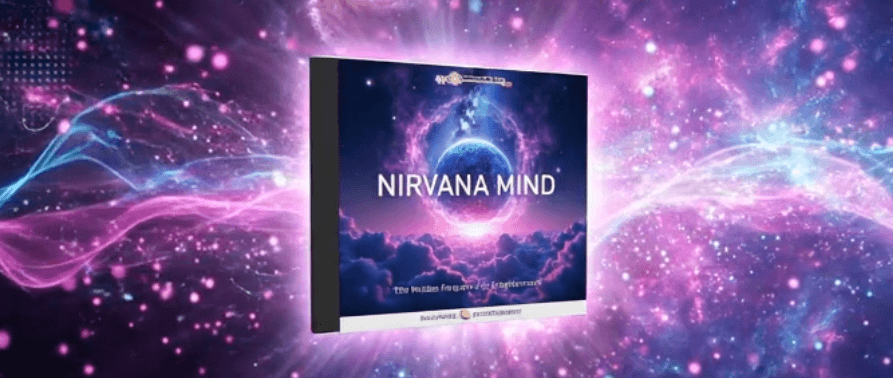
Nirvana Mind is our new frequency composition that translates these research findings into a 45-minute protocol. The session guides you through five phases that systematically bring your default mode network to rest:
- Epsilon waves (0.001-0.5 Hz) create the deepest stillness, the state researchers describe as a "suspended animation" of the sense of self
- Delta waves (0.5-4 Hz) synchronize communication within the DMN
- Gamma suppression (60-140 Hz) specifically deactivates the self-referential loops in the prefrontal cortex
- Lambda peaks (above 100 Hz) open the door to transcendent breakthroughs
The result: you train your brain with the signature of people whose inner commentator has gone permanently quiet.
Nirvana Mind
€39,95
Erfahre, was bleibt, wenn du loslässt, wer du zu sein glaubst Du sitzt in der Meditation, wieder, zum tausendsten Mal. Du kennst den Zustand – du hattest ihn, vielleicht sogar mehrfach. Einheit, Stille, dieses Gefühl, dass alles eins ist. Aber… Mehr erfahren

Who is Nirvana Mind for?
This frequency isn't for beginners. It's meant for experienced meditators who know the difference between temporary states and lasting transformation, and who are ready to go beyond collecting experiences.
If you already use Buddha Mind or Infinity Mind and sense that something more is waiting, Nirvana Mind is the next step. It isn't one more state for you to reach. It's the end of the search itself.
FAQs
How is Nirvana Mind different from Buddha Mind?
Buddha Mind works with 40 Hz gamma waves for deep bliss and meditative peace. Nirvana Mind goes one step further: it uses epsilon waves below 0.5 Hz to systematically bring the default mode network to rest, for lasting rather than temporary awakening.
Do I need meditation experience for Nirvana Mind?
Yes, this frequency is designed for experienced meditators. We recommend at least a few months of regular meditation practice and, ideally, experience with our other advanced frequencies such as Infinity Mind or Buddha Mind.
How often should I use Nirvana Mind?
We recommend a 21-day protocol: every other day in the first week, daily in weeks two and three, then every other day again for integration. You'll find the details in the full usage guide on the product page.
What is the default mode network?
The default mode network (DMN) is a network of brain regions that becomes active when we're not focused on external tasks. It's responsible for self-reference, rumination and the sense of a separate "I". Studies show that meditation reduces DMN activity.
Is enlightenment guaranteed with Nirvana Mind?
No, and anyone who promises you that is lying. Enlightenment isn't a product you can buy. What Nirvana Mind offers is a scientifically grounded tool that trains your brain with the frequency patterns measured in people living in lasting awakening. Dr. Jeffery Martin's research shows that 73% of participants using targeted protocols experienced a transition to lasting awakening within four months. But that took daily practice and dedication, not just listening to a frequency. Nirvana Mind can support and accelerate this process.
How long does it take to feel results with Nirvana Mind?
That varies a lot from person to person. Some people notice an unusual depth and stillness in their very first sessions. Others need several weeks of regular use before noticeable changes show up in everyday life. What the research does show is that lasting changes in the brain require regular training over a longer period. That's why we recommend the 21-day protocol as a minimum, and use over several months for deep transformation.
Can Nirvana Mind make me lose my personality?
No. Research shows that people in lasting awakening keep their personality, their abilities and their relationships. What changes is the suffering caused by their own personality: the constant brooding, the self-doubt, the inner critic. You won't turn into an emotionless robot. Quite the opposite: many people report deeper empathy and more authentic relationships because fear and self-absorption fade.
What exactly is enlightenment from a scientific point of view?
Researchers deliberately avoid religiously loaded terms. Dr. Martin uses the term "Persistent Non-Symbolic Experience" (PNSE), a lasting state in which the usual symbolic thinking (the constant inner commenting, judging and self-focus) is greatly reduced or absent. People in this state report ongoing inner peace, the disappearance of fear and worry, and a feeling of connectedness instead of separation. Rather than a mystical state, it's a measurable change in the way the brain processes information.