

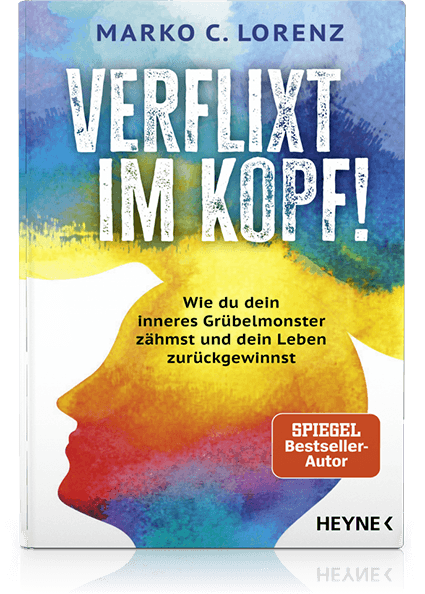
For up to 30 percent of people, the mind never stands still. Thoughts go round in circles and steal sleep and energy. In my new book "Verflixt im Kopf!" (available in German), I show why your brain works like a chaotic shared apartment, who's really in charge there, and how the ClearMindCode helps you find real mental quiet in 5 to 10 minutes a day.
When your mind won't stop
2:43 a.m. You're lying on your side, you've flipped your pillow for the third time, the blanket is half kicked off. Your body is tired, your eyes are burning. And still your mind keeps churning: yesterday's conversation with your coworker. The unpaid bill. Whether you said the right thing at the parent-teacher meeting. And then, somewhere between worry and exhaustion, a scenario pops up that will probably never happen, yet in this moment feels like an absolute certainty.
You want to stop overthinking. You try. And that's exactly what makes it worse.
Studies show that people who ruminate a lot genuinely believe they're working on a problem. In reality, they're just going through the next loop of thoughts. Rumination feels like thinking, but it's more like mental gum chewing. Your brain whispers to you: "I'm working on a solution right now." Sounds good. Unfortunately, it isn't true.
What constant rumination does to your life
Racing thoughts cost you more than just sleep. You wake up in the morning feeling as if you hadn't slept at all. Your concentration crumbles. In the meeting you're listening, but really you're somewhere between worrying about your bank balance and wondering why your friend reacted so strangely yesterday. You snap at little things. Your partner asks "Everything okay?" and you say "Yes," even though nothing is okay.
Psychologist Bona Lea Schwab describes the mechanism like this: during the day we're distracted, and our to-do lists keep us busy. In the evening the outside noise dies down and we're thrown back on our inner world. The thought carousel has free rein.
The most dangerous point comes when rumination becomes part of your identity. When you start saying: "That's just how I am. I simply think too much." At that point you've stopped looking for a way out.
Psychotherapist PD Dr. Tobias Teismann of Ruhr University Bochum has been researching rumination for years, the technical term for pathological brooding (from the Latin ruminare, to chew the cud). His finding: rumination actively keeps depressive states going. It isn't a symptom. It's an amplifier.
Maybe you've already tried a lot: meditation, journaling, mindfulness apps, the well-meant advice to "just think of something nice." The problem is that most approaches only treat the surface. They tell you what to do, but not why your mind works this way in the first place. What's missing is the user manual for the device between your ears.
"Verflixt im Kopf!" delivers exactly this user manual. And it starts with an image that's so illuminating you'll never look at your own thinking the same way again.
Your brain is a shared apartment: the roommates behind your racing thoughts
Imagine your brain as a shared apartment. Several roommates, each with their own character, their own needs, their own quirks. Some are helpful, some are annoying, and one of them regularly makes your nights hell. In my book, each of these roommates gets a name and a role. That sounds funny at first, but there's a serious point behind it: once you understand who is actually talking up there, you can start to stop the thought carousel.
The roommates at a glance
Kevin (prefrontal cortex)
The overwhelmed house manager. Wants to plan everything, control everything, keep everyone happy. And regularly hits his limits in the process.
Torsten (amygdala)
The panic center. Reacts to anything that even remotely smells like danger. His motto: better to sound the alarm once too often than once too rarely.
Ralf (hippocampus)
The archivist. At half past two in the morning he fetches embarrassing memories from the basement and spreads them out in front of you. Preferably the ones from 2014.
The Gambler (nucleus accumbens)
Chases dopamine kicks. Would rather scroll through social media for another hour than let you go to bed. Short-term fun beats long-term well-being. Every. Single. Time.
Maximilian (medial prefrontal cortex)
The ego. Constantly busy with the question of how you come across to others. Takes everything personally and turns every situation into a story about you.
Thinky (Default Mode Network)
The rumination monster. Picks up everything the other roommates drop, crafts endless thought loops out of it and sells them to you as "your thoughts." His favorite phrase: "But what if...?"
The punchline of the roommate metaphor: you are none of these roommates. You are the consciousness. The observer. The landlord sitting in front of the security cameras who finally sees who's actually making all the noise. And the landlord can set house rules.
As soon as you make this distinction, something interesting happens: you stop identifying with every thought. You realize that "thinking too much" isn't a personality trait. It's a pattern. And patterns can be changed. Research on neuroplasticity has confirmed this for decades: your brain is constantly remodeling itself, forming new connections and letting old ones wither. The only question is whether you steer this process consciously or let Thinky do it for you.
Your rumination monster has a name. Want to meet it?
In "Verflixt im Kopf!" you'll meet all the roommates, understand how they operate, and with the ClearMindCode you get a proven system to get rid of negative thoughts and find real inner peace.
What "Verflixt im Kopf" gives you: stop overthinking in three steps
The book has three parts that build on each other. No esoteric beating around the bush. No "just think positive." Concrete tools based on neuroscience.
📊 The three parts of the book
The 9 phases every thought goes through, from trigger to action. Once you understand this, you'll never see your thinking the same way again. You'll learn the mechanisms behind the thought carousel and why your brain works the way it does.
The ClearMindCode: a 7-day program, 5 to 10 minutes a day. Based on neuroplasticity. You literally build new neural connections that stop rumination and help you establish a quiet mind as your new normal.
Everyday integration, handling setbacks, lasting change. Because everyone knows how it goes: you have a tool, it works, and three weeks later you've forgotten about it. Part 3 makes sure that doesn't happen.
⚡ The principle
256 pages written for people who think too much and finally want to find inner peace. No theory without practice. No promise without a method.
What sets this approach apart from many others: you don't try to force your thoughts into silence. That doesn't work anyway (try not to think of a pink elephant). Instead, you learn to see through the structure of your thinking. And once you see through the structure, your thoughts lose their power over you. It's like a magic trick when you know how it's done: it may still fascinate you, but it no longer controls you.
Psychologists call this cognitive defusion. In my book it's put more simply: you stop taking Thinky's monologues for the truth.
About me
I'm Marko C. Lorenz, a SPIEGEL bestselling author, consciousness researcher and founder of the Brainwave Entertainment Research Institute. I've spent more than 20 years studying the mechanisms of the mind, I run my own EEG lab, and I've collected more than 1,000 documented consciousness experiences. Before I got into consciousness research, I worked as a court-appointed expert in IT forensics. That job taught me to separate data from interpretation, and at the same time it showed me firsthand what a constantly overactive mind can do.
"Verflixt im Kopf!" is published by HEYNE Verlag (Penguin Random House) and is available as a paperback, e-book and audiobook (read by Sebastian Fuchs). You can find it in bookstores, at Thalia, Amazon, Hugendubel and wherever books are sold.
| Author | Marko C. Lorenz |
| Publisher | HEYNE / Penguin Random House |
| Length | 256 pages |
| Formats | Paperback, e-book, audiobook |
| Audiobook narrator | Sebastian Fuchs |
| Core method | ClearMindCode (7 days) |
| Daily time commitment | 5 to 10 minutes |
Stopping overthinking starts with understanding
If you're reading this article because you're in the middle of a phase where your mind just won't settle down: you're not "broken." You're not "too sensitive." And you're definitely not alone. Christel Petitcollin estimates that in up to 30 percent of people, the right hemisphere of the brain is so dominant that the mind runs at full speed all the time. Racing thoughts aren't a sign of weakness. They come from a brain that nobody ever showed where the off switch is.
"Verflixt im Kopf!" provides those instructions. Not as a theory that sounds good and gathers dust on the shelf, but as a program you can put into practice right after reading. 5 to 10 minutes a day. 7 days. And then see what happens when you notice for the first time that your mind has gone quiet.
[INTERNAL: If you're interested in sleep and rumination, you'll find more science-based approaches in our article on sleep problems and techniques for falling asleep.]
[INTERNAL: You can learn more about the Default Mode Network and its role in meditation in our guide to brainwave entrainment.]
A personal request: If the book helps you, please leave a short review on Amazon in the first few days after your purchase. Three sentences are enough. The first reviews play a major role in whether the book becomes visible and reaches other people who need a manual for their mind just as urgently as you do.
Ready to tame your rumination monster?
"Verflixt im Kopf!" is available as a paperback, e-book and audiobook. 256 pages that show you how to stop the thought carousel and find real mental quiet. Available in bookstores, at Thalia, Amazon, Hugendubel and wherever books are sold.
Frequently asked questions
Can you really stop your thoughts, or is that just a promise?
It's less about forcing your thoughts into silence. That has been shown not to work. The approach in my book is based on the principle of cognitive defusion: you learn to observe your thoughts without identifying with them. The result is a kind of mental quiet in which rumination loses its power over you. Neuroplasticity research shows that regular training really does change neural patterns.
How much time do I need to set aside for the ClearMindCode?
The ClearMindCode program is designed to run for 7 days and takes 5 to 10 minutes a day. That fits into any morning routine, your lunch break, or the last few minutes before you fall asleep. The time commitment is deliberately low, because experience shows that most people stick with programs that demand 45 minutes a day for exactly three days.
Do I need meditation experience for the book?
Nope. The book is written for people who have never meditated, as well as for those who have been practicing for years and still can't shake the thought carousel in bed at night. The roommate metaphor makes complex brain processes easy to understand without assuming any technical jargon. If you can read, you can use the ClearMindCode.
Where can I buy "Verflixt im Kopf!"?
Wherever books are sold: at your local bookstore, at Thalia, Amazon, Hugendubel and other retailers. Available as a paperback, e-book and audiobook (narrated by Sebastian Fuchs). You'll find all the info and ordering options at verflixt-im-kopf.com.