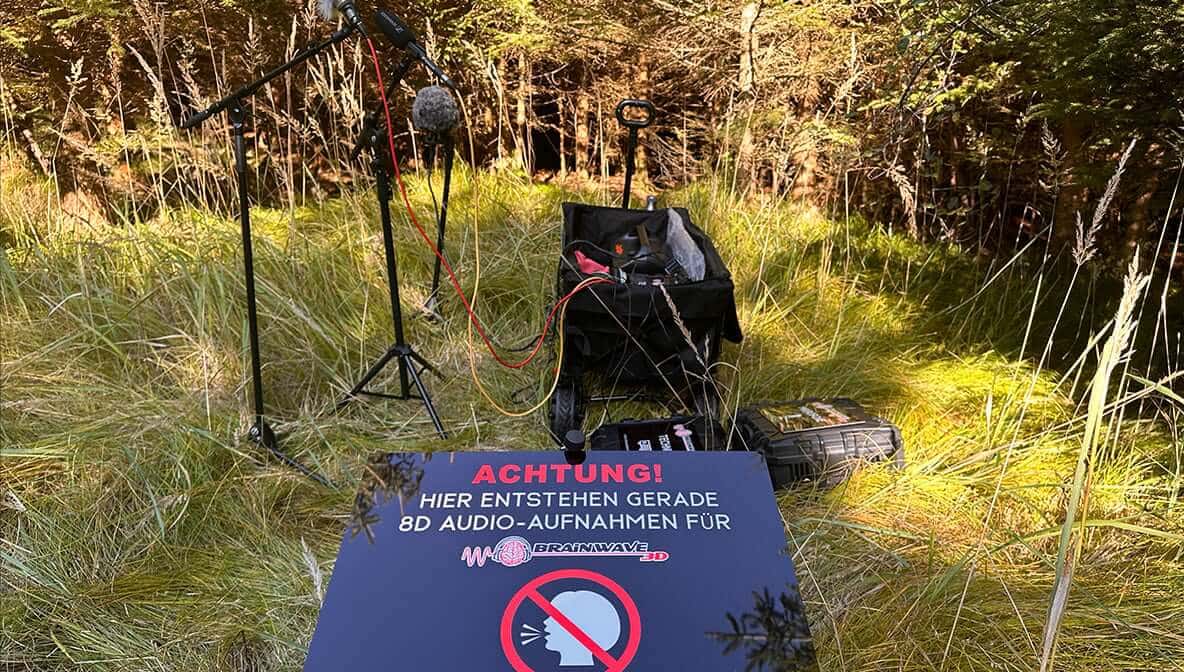
A few days ago I wanted to record some nature sounds in the forest. You won't believe what happened next. And it explains everything about what's going wrong with our brains.
I spend an hour packing up my gear. Microphones, cables, recorder, windscreens: everything has to come along. Then almost an hour's drive into the forest. I know this perfect spot there, far away from everything.
Then another hour to find THE perfect place. You can imagine: not too close to the road, no flight path overhead, the right acoustics. Everything has to be just right.
For 30 minutes I drag my handcart over rocks and roots. The thing almost falls apart. I'm sweating. But who cares, it's almost time.
Finally, all the microphones are wired up. Every angle is calculated and everything is set up perfectly. The birds are chirping, and the wind is rustling softly through the leaves. Perfect conditions.
The moment of truth. I hit record.
Nothing.
No SD card.
I left it at home...
The whole day wasted. Four hours of work, and I forgot the single most important thing.
What really gets to me...
Is that something like this can happen to me at all. That my brain forgets the most important thing while remembering every bit of useless trivia.
The route to the forest? Stored. Where I recorded a woodpecker three years ago? I remember it exactly. The SD card? Nowhere to be found.
And you know this feeling too, right?
You remember that embarrassing moment from 15 years ago as if it were yesterday. Every stupid advertising jingle from the '90s.
But where you put your keys five minutes ago? No idea. The name of the person you were just introduced to? Gone. Did you turn off the stove? Panic.
Our brain stores every bit of junk but forgets what matters most.
The Harvard study that opened my eyes
I already knew the famous Harvard study that sheds light on all of this: after 40, our brain shrinks by 5% per decade.
But that's not even the worst part.
The real problem is that over time our brain builds "highways" for our habits. Neurological expressways on which our thoughts keep driving the same route, along the same neural pathways, again and again.
Take a look at your day:
Get up → coffee → phone → work → Netflix → sleep → repeat
These highways determine everything:
- That's why you always react the same way when someone criticizes you
- That's why you always reach for chocolate when you're stressed
- That's why you check your phone every five minutes
- That's why you forget important things: your brain is running on autopilot
You're no longer thinking. You're just functioning.
It was exactly the same for me. I thought of everything: charged batteries, packed windscreens, even spare cables. But the SD card? It wasn't part of my routine. It wasn't on my neurological highway.
The good news that changes everything
But here's the good news: your brain can build new roads. It can completely rewire itself, leave those old highways behind and lay down fresh paths.
This is called neuroplasticity, and you can train it.
Here's what happens when you train your neuroplasticity:
- You remember names instantly (instead of forgetting them three seconds later)
- You learn new skills in days instead of weeks
- Your old triggers lose their power
- You stop reacting like a robot
- Your brain becomes flexible instead of rigid
In short: you become the pilot of your own life again.
The 7 techniques I should have known
There are 7 simple techniques for this. Techniques that wake your brain up from its half-sleep. With these techniques (which, by the way, I've known for years!) my brain would have been awake, and the SD card would have been in my backpack.
These techniques are based on the latest findings in neuroscience. They force your brain to leave the old highways, form new connections and wake up again.
I could have used them sooner. Before my forest adventure. Before all the other forgotten SD cards, keys, appointments...
My lesson from the forest
That forgotten SD card in the forest was my wake-up call. The moment I realized my brain was running on autopilot.
We forget important things and always react the same way. We live in an endless loop, functioning instead of living.
But it doesn't have to stay that way. Neuroplasticity is real, the techniques exist, and science has cracked the code.
The only question is: do we stay on our neurological highway, or do we take action and build new roads?
Want to learn the 7 techniques that take your brain off autopilot?
The same techniques that would have made sure my SD card was in my backpack today? → YES, show me how to switch off autopilot