What happens in the last moments of our lives? A groundbreaking study from the University of Michigan has made the impossible possible: the researchers measured consciousness during the process of dying, and the results shake everything we thought we knew about death.
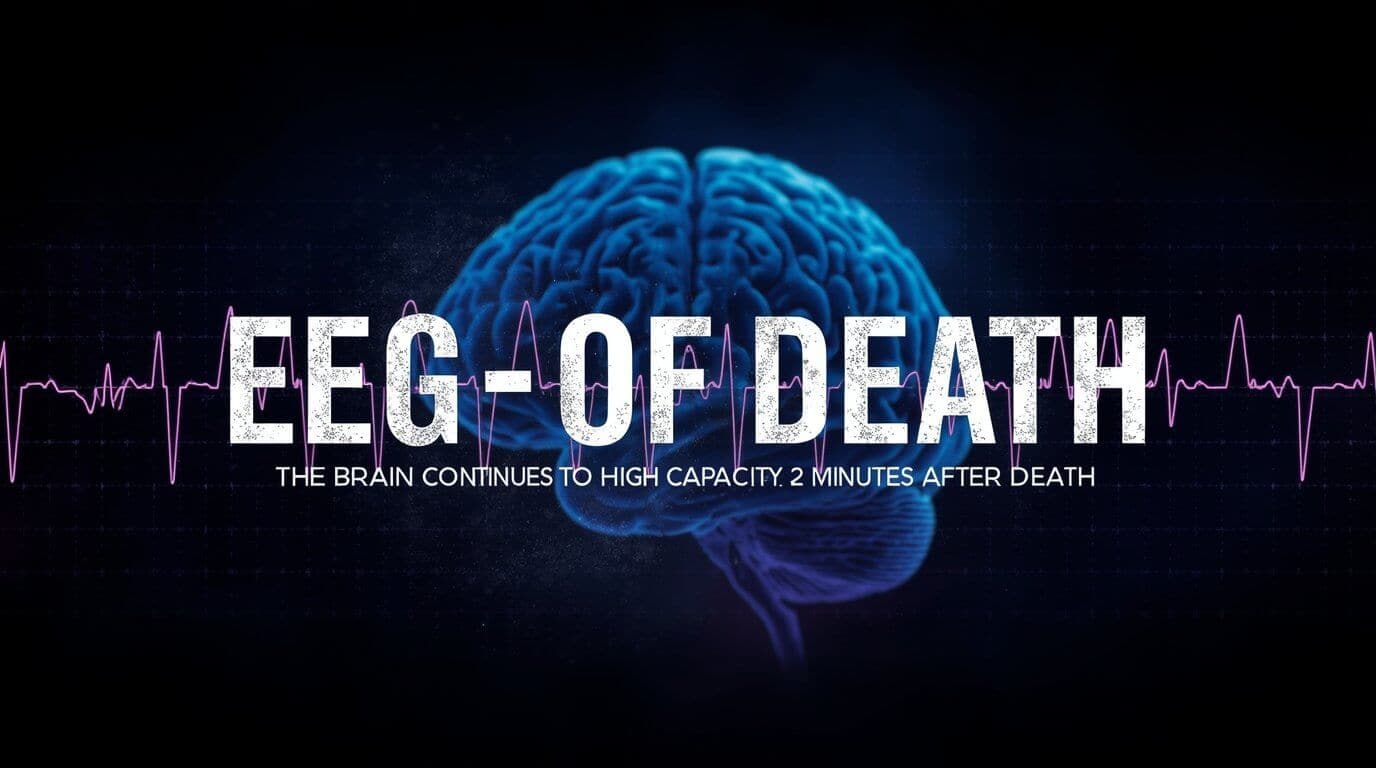
Imagine this: your heart stops beating. Your breathing goes silent. Doctors declare you clinically dead. But at that very moment, a neural firework display ignites in your brain that is more intense than anything you've ever experienced in your life. Welcome to the fascinating world of "EEG of Death" research.
The moment that revolutionized neuroscience
It started with four patients in the intensive care unit. All of them were unconscious, all of them were dying. Their families had made the difficult decision to switch off life support. What the University of Michigan researchers hadn't expected: in the moments after cardiac arrest, brain activity exploded like a supernova.
The numbers are staggering: in two of the four patients, gamma wave activity increased eightfold after clinical death. These brainwaves, which are normally associated with the highest levels of consciousness and with spiritual experiences, reached intensities that have never been measured even in the deepest meditation.
What are gamma waves and why do they matter so much?
Gamma waves oscillate between 25 and 150 Hz and are considered the "gold standard" of consciousness. When monks reach their deepest spiritual states after 20 years of meditation, it's gamma waves that accompany their enlightenment. In the dying patients, however, these waves reached dimensions that went beyond anything known.
Especially fascinating: the activity was concentrated in the so-called "hot zone" of consciousness, the brain region between the temporal, parietal and occipital lobes that is responsible for dreams, visions and out-of-body experiences.
The secret of coupled frequencies
The study's most revolutionary finding: the dying brain doesn't just produce individual frequencies. It produces complex couplings between different brainwaves.
The researchers documented precise connections between:
- Theta waves (7-9 Hz) coupled with low gamma (30-40 Hz)
- Alpha waves (10-15 Hz) synchronized with upper gamma (42-56 Hz)
- Beta waves (13-25 Hz) in resonance with high gamma (80-150 Hz)
These patterns aren't random. They match exactly the frequency signatures measured in living people during the deepest spiritual and mystical experiences.
The epsilon-lambda connection: neuroscience's biggest mystery
Alongside the gamma surges, the researchers discovered an even more mysterious phenomenon: epsilon waves below 0.5 Hz, so slow that most EEG devices can't even measure them.
This is where it gets really wild: these ultra-slow epsilon waves are directly coupled with ultra-fast lambda waves (100-200 Hz). If you zoom far enough into an epsilon wave, you find a racing lambda wave embedded inside it. It's as if consciousness embodies both the slowest and the fastest oscillation in the universe at the same time.
Near-death experiences: finally explained by science?
Millions of people report near-death experiences: leaving the body, tunnel vision, meeting deceased loved ones, seeing their life flash before their eyes. Until now, these reports were often dismissed as hallucinations. "EEG of Death" research now provides the neurobiological basis.
The evidence is piling up:
- 30-100 Hz gamma activity correlates with visual hallucinations
- 6.3 Hz theta waves are responsible for memory recall (the life review)
- 10 Hz alpha activity enables expanded perception
- A 0.25 Hz epsilon state creates the feeling of oneness and transcendence
The case of the 87-year-old man: the first measured "life review"
In 2022, researchers documented the "life review" of a dying person for the first time. An 87-year-old man died of a heart attack while his EEG was being recorded. What they saw changed everything.
In the 30 seconds before and after his cardiac arrest, gamma waves surged in his memory center. The activity patterns closely matched those that occur when we recall important life events. His brain was literally replaying his entire life, exactly as near-death experiencers describe it.
The dark side: not everyone sees the light
But the research also reveals a darker truth: not everyone who dies experiences these consciousness-expanding gamma surges. Only about 46% of all patients show this activity. The others slip quietly into darkness.
Interesting: both patients in the Michigan study who showed the gamma surges had a history of epilepsy. This could mean that certain neuroplastic changes "prepare" the brain for these final states of consciousness.
What really happens after death?
The "EEG of Death" studies raise more questions than they answer:
Do we actually experience something after physical death? The gamma activity lasts up to 2 minutes after cardiac arrest. In brain time, that's an eternity.
Is consciousness more than just neural activity? The frequency couplings follow patterns known in quantum physics as "coherence".
Can we reach these states while we're alive? This is where it gets really exciting...
The Tibetan monks were right
For centuries, Tibetan monks practiced meditation techniques to consciously enter "death-like" states. They called it "bardo", the intermediate state between life and death. Modern neuroscience now confirms it: they were right.
EEG measurements of experienced meditators show the same gamma-theta couplings as those seen in the dying patients. These monks can deliberately enter states of consciousness that correspond to dying, and then come back.
The Wim Hof effect: modern "death states"
"Iceman" Wim Hof also reaches similar states through extreme breathing techniques and cold exposure. His EEG patterns while meditating in freezing cold show the same epsilon-lambda couplings found in research on dying.
The technology of consciousness: brainwave entrainment
Here comes the revolutionary insight: if we know the exact frequencies, we can reproduce them. Modern brainwave entrainment technology makes it possible to simulate the "EEG of Death" patterns safely and in a controlled way.
Scientific studies show that precise acoustic stimulation can get the brain to produce specific frequency patterns:
- Binaural beats for the middle frequencies (theta, alpha, beta)
- Isochronic tones for the extreme ranges (epsilon, gamma, lambda)
- Frequency couplings for the complex "death state" patterns
The 4 phases of conscious death simulation
Phase 1: The descent (0-20 min) A ramp from normal consciousness down to 0.25 Hz epsilon waves. The ego begins to dissolve.
Phase 2: The gamma surge (20-40 min) Simultaneous activation of 40 Hz, 80 Hz and 150 Hz gamma waves. Visions and mystical experiences set in.
Phase 3: Frequency coupling (40-60 min) Theta (6.3 Hz) + alpha (10 Hz) + gamma (80 Hz) in perfect synchronization. The documented "death state".
Phase 4: Transcendence (60+ min) All frequencies united: epsilon-lambda coupling. Complete expansion of consciousness beyond human experience.
Critical voices and scientific context
Not all scientists are convinced. Critics such as Dr. Bruce Greyson argue that the gamma activity could also be a final "flare-up" of the dying brain, a kind of neural "death throes" without any conscious experience.
But the counterarguments are strong:
- The frequency patterns are too organized to be random activity
- The activation of the "hot zone" is specific to consciousness
- The duration (up to 2 minutes) is too long for mere reflexes
- The similarity to meditative states is too precise
The future of consciousness research
The "EEG of Death" studies are only the beginning. Researchers are already planning larger studies with 1,000+ patients to confirm and understand these phenomena.
The big questions of the next decade:
- Can we use "death states" therapeutically?
- Can traumatic near-death experiences be prevented?
- Is consciousness fundamentally separate from brain activity?
- Can we prepare dying people for their "journey"?
A new understanding of life and death
This insight is a paradigm shift: death may not be the end of consciousness at all. It may be its most intense moment. 46% of all people go through states of consciousness in their last minutes that surpass anything possible in life.
This research doesn't just change our understanding of dying. It also revolutionizes how we see life. If such extreme states of consciousness are possible, what untapped potential lies dormant in our brains?
The bridge between science and spirituality
For the first time in history, the gap between scientific research and spiritual experience is closing. What mystics, shamans and meditators have described for thousands of years is now being measured and understood in the lab.
"EEG of Death" research proves it: consciousness is far more complex and powerful than we ever imagined. Death may be the end of the body, but for consciousness it could be the beginning of the greatest adventure.
Experience the death-state frequencies yourself: Ad Astra
Fascinated by the scientific findings on states of consciousness during dying? Ad Astra uses the exact frequency patterns from the "EEG of Death" studies to take you on a safe journey into these extraordinary dimensions of consciousness.
This advanced consciousness technology reproduces the documented gamma-theta-alpha-epsilon couplings from the University of Michigan study. Through precise brainwave entrainment technology, you experience the intense neural states that normally occur only in the last moments of life, without the dangers of physically dying.
Ad Astra guides you through the 4 scientifically documented phases:
- Epsilon consciousness (0.25 Hz) for ego dissolution
- Death gamma surge (80-150 Hz) for mystical visions
- Frequency coupling (6.3 + 10 + 80 Hz) for the authentic "death state"
- Lambda-epsilon transcendence for complete expansion of consciousness
Based on more than 4 decades of EEG research and the latest findings from research on dying, Ad Astra opens doors to dimensions of consciousness that monks only reach after 20 years of intensive meditation.
The future of consciousness begins today. Are you ready for your journey to the stars?
Ad Astra
€39,95
Tiefer als dich Meditation je führen kann Stell dir vor... Du liegst still, mit geschlossenen Augen. Die Welt zieht sich zurück. Ein Gefühl macht sich breit, das du nicht einordnen kannst. Zeit scheint sich aufzulösen, als würde etwas Größeres gleich… Mehr erfahren